The Hope Center for College, Community, and Justice at Temple University
Remote — Philadelphia
New Product Build
2022

The Hope Center for College, Community, and Justice at Temple University

The Hope Center wanted to modernize the nation’s largest assessment of students’ basic needs used by 500+ colleges and universities (which was being hand-compiled via PDF). Their 65 partner institutions were looking for faster and more precise survey data to help them provide targeted support, since meeting those needs directly impacts graduation rates and career trajectories.

Contract

Problem

The Hope Center for College, Community, and Justice at Temple University is a research center focused on making higher education more effective, equitable and impactful.

As part of their applied research, they produce two rigorous reports on insecurity in students’ basic needs — food, housing, transportation, healthcare, childcare — for 500+ colleges and universities. Since challenges in these areas negatively impact graduation rates (and subsequent outcomes), colleges want to make sure they understand the needs of their students to best help them stay in school and graduate.

Both reports stem from surveys conducted on campus by The Hope Center:
• The #RealCollege Survey asks students about the issues they’re facing
• The Campus Ecosystem Assessment surveys faculty members, staff, and campus administrators to gauge how effectively they feel the school is providing for students’ basic needs

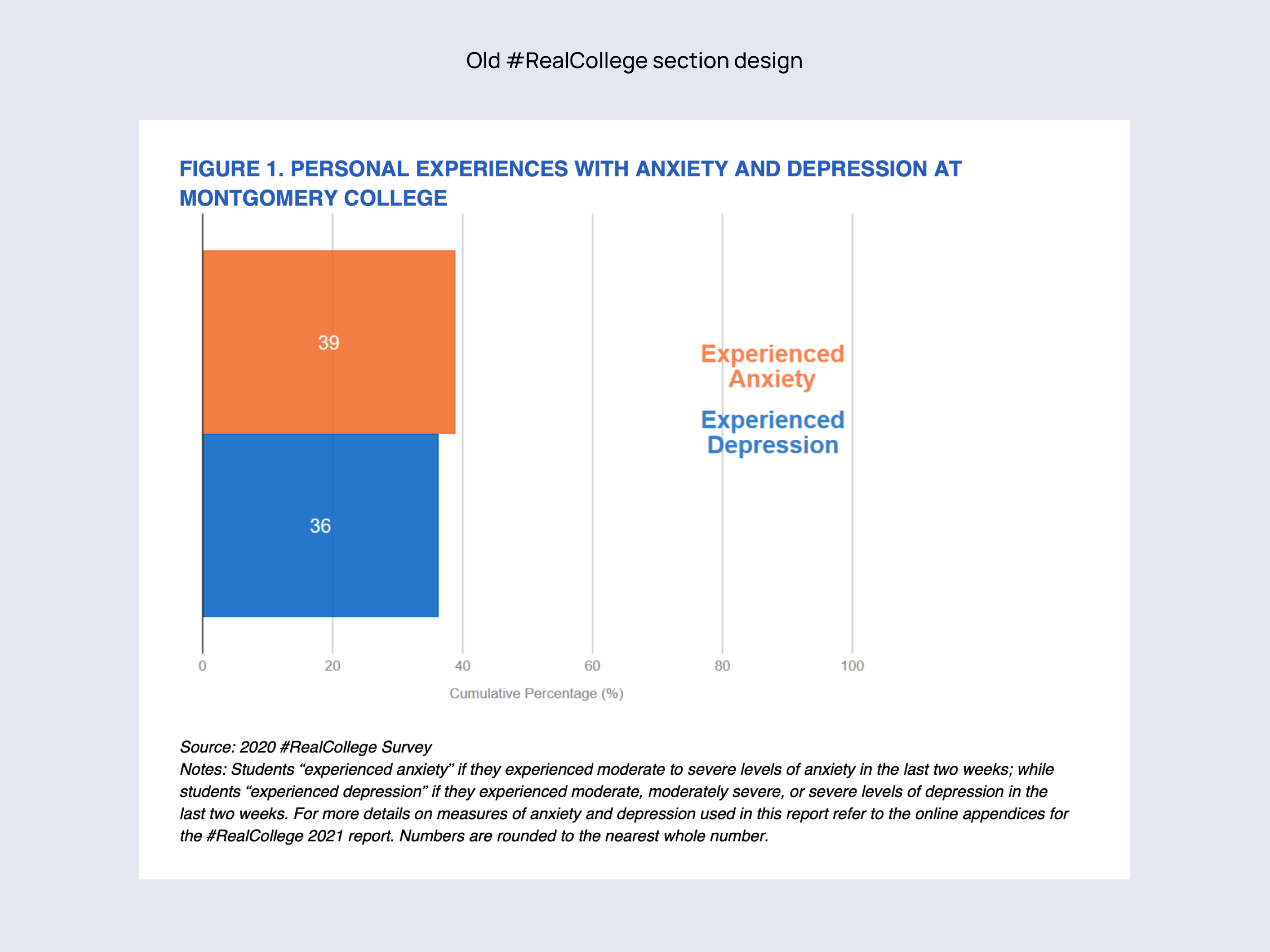
Previously, these reports were being compiled manually from Qualtrics data. The process was so time intensive that the final PDFs were often outdated because of the many months it took to produce them, reducing their usefulness. And the graphics were often confusing.

Goal

For the MVP of the product, we had two goals:
1. Drastically shorten the turnaround time for creating reports
2. Improve the reporting interface so institutions can drill into interesting aspects of their data through filtering and disaggregation to understand the impact on specific groups

For the product to succeed, institutions need to be able quickly access data and make adjustments to help students before it’s too late.

Role

As a contractor, I:
• Led product design
• Created all designs for the MVP
• Formed a trio with the program director and the head of engineering
• Conducted research on best design practices for disaggregated data
• Expanded the brand guide for accessible colors, fonts and logos

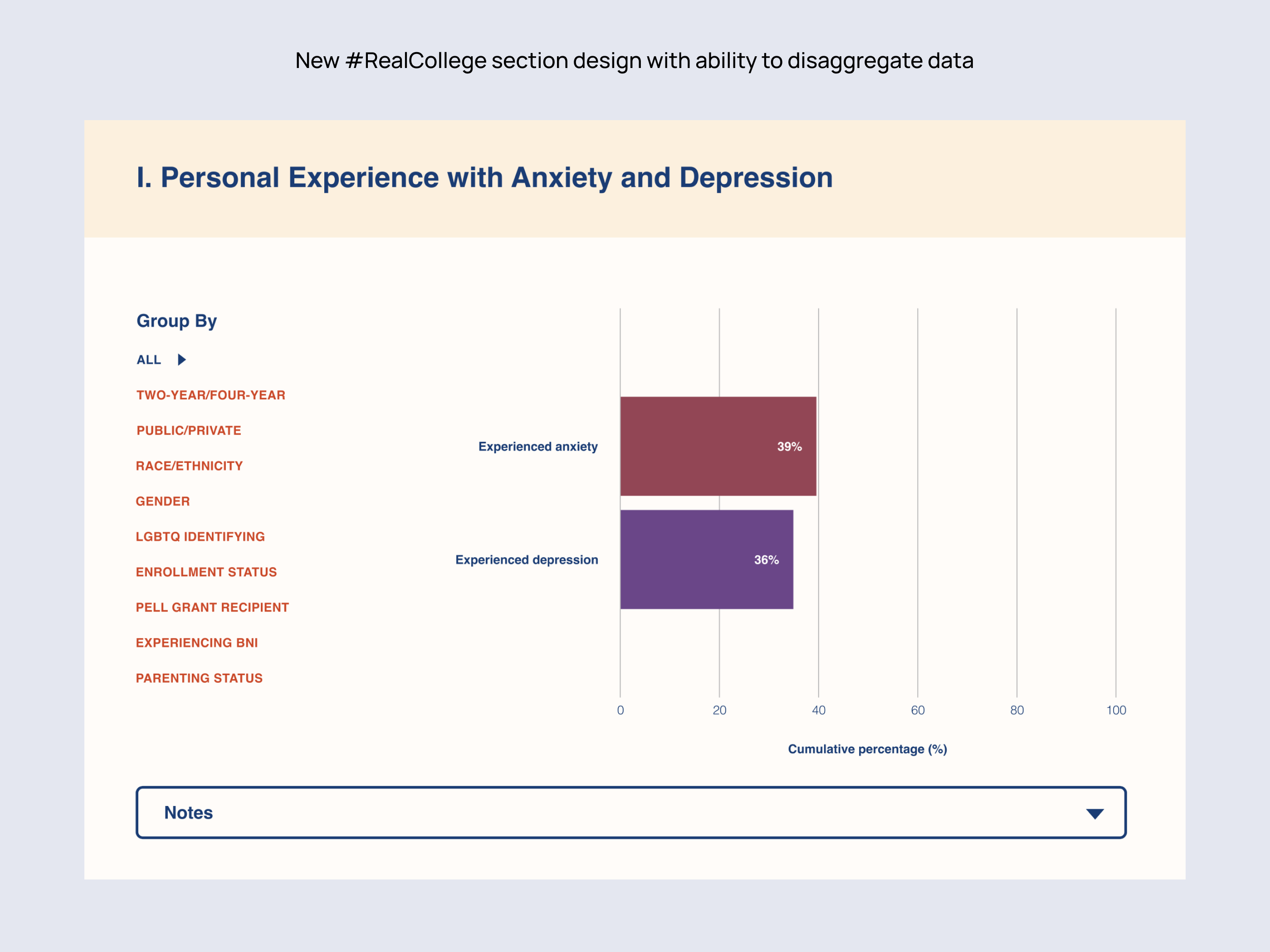
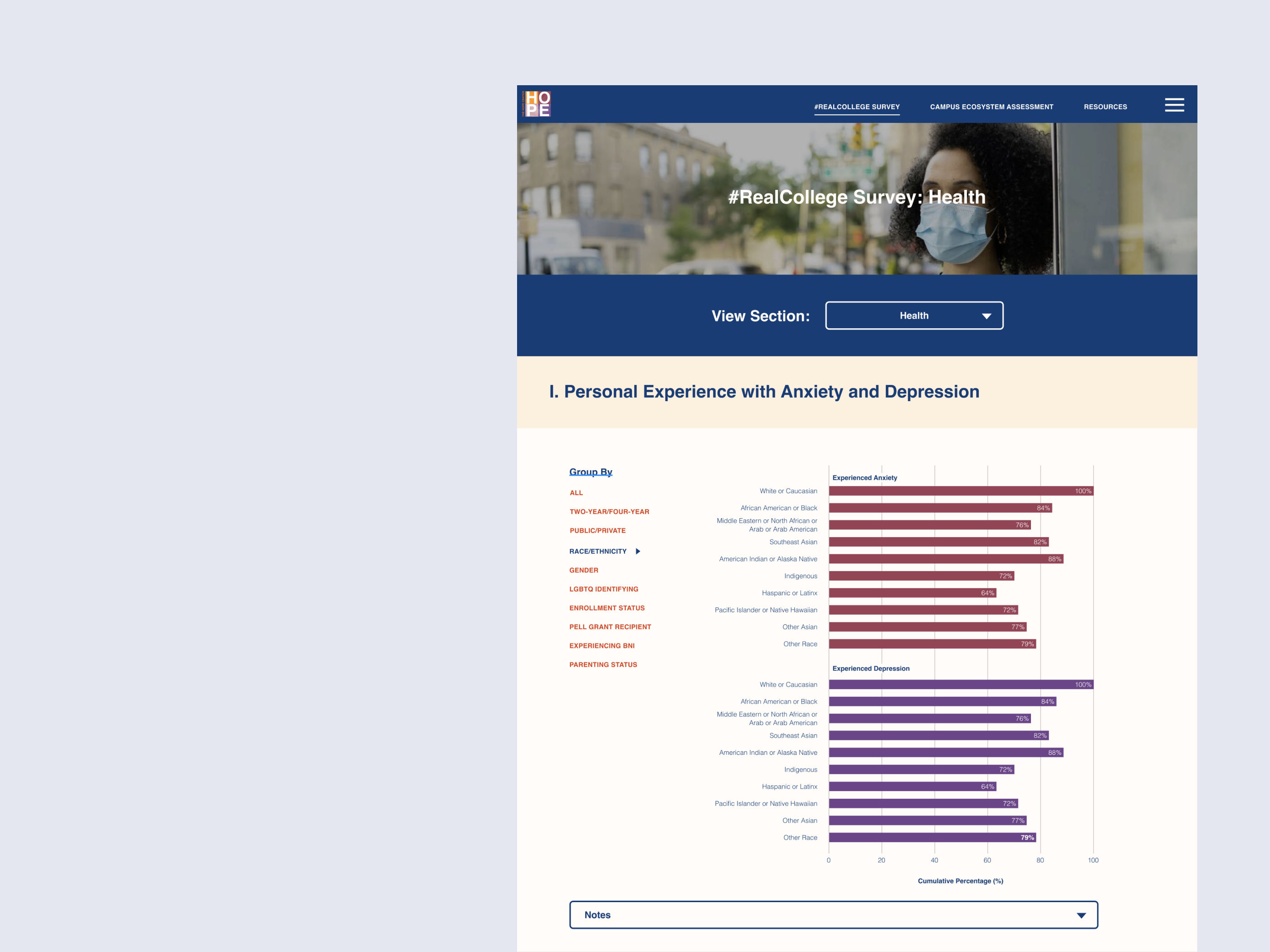
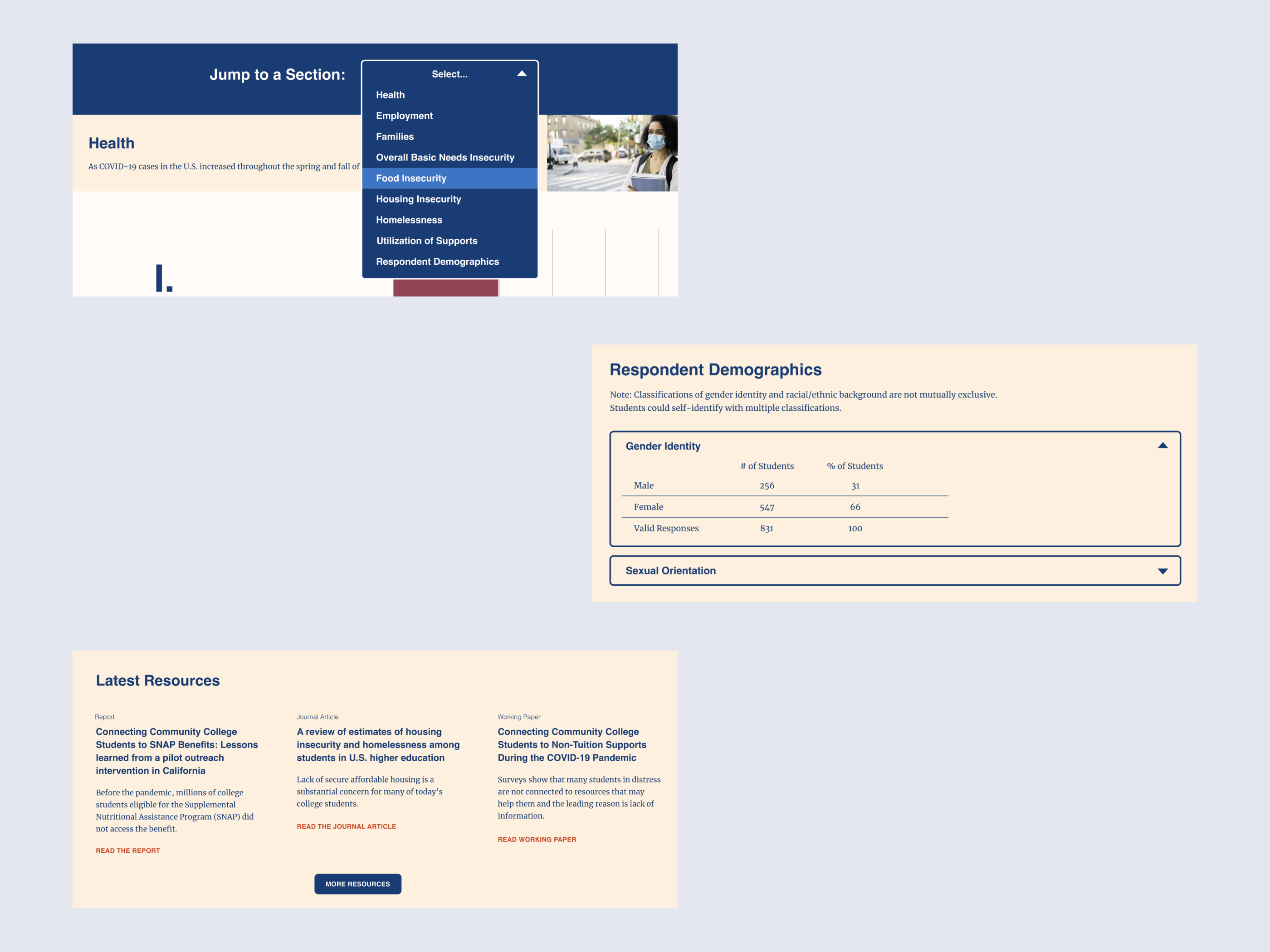
New survey data module showing disaggregated data bar chart
Old survey module bar chart
No items found.

Strategy Development

I wanted to build something that was easily scalable and customizable for each institution, without requiring a staff member to write anything in order to complete the report. In auditing the existing reports, I spotted several sections of written content that were redundant with what was being delivered graphically, which helped lay the groundwork for a more condensed content strategy.

Beyond the reports themselves, my marketing experience drove me to advocate for an architectural structure that would take advantage of existing relevant research the Center had published to help institutions formulate a plan after consuming their reports.

Architecture

As a subscription product, the dictating factor for what a user sees is based on which reports their institution has purchased.

To standardize the experience, and to avoid prioritizing one report over the other, I included:

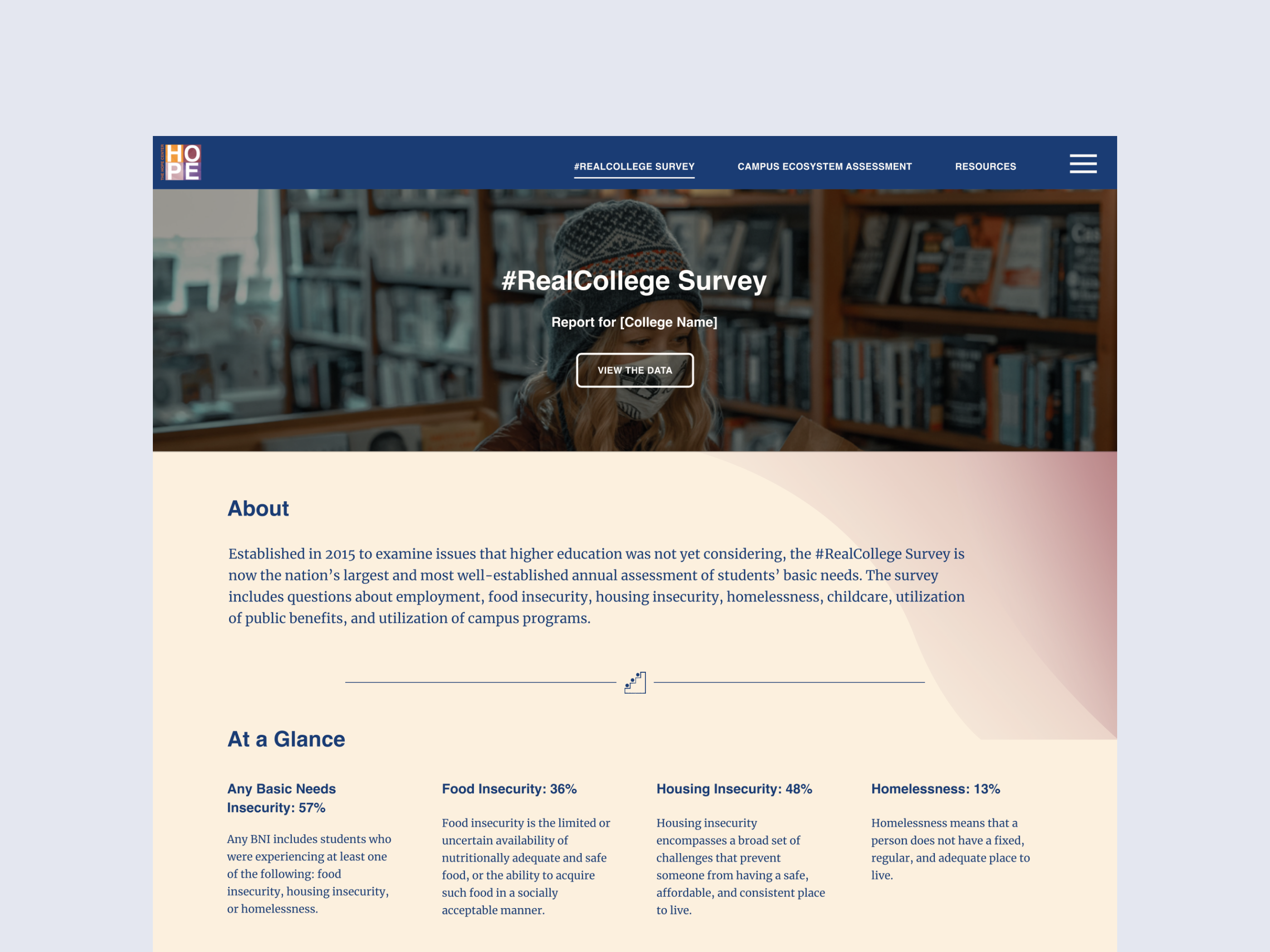
• A dynamic homepage that allows for a contextual introduction to each report, as well as a way to highlight the latest news

• A main page for each report. For usability (and shareability) on the #RealCollege survey, separate subpages for each topical section

• A resources section that pipes in articles from the main Hope Center website, delivering timely answers to the “now what?” question that inevitably arises from school administrators

• An About section to explain the initiative and to talk about The Hope Center's evolving research

Product Design

While there were existing print reports and a new set of brand guidelines, neither proved ready for the task at hand. The color palette wasn’t WCAG/508 compliant, and the use of colors was inconsistent and confusing. Additionally, there was only one approved font, and it only had two weights.

To expand our design options, I started with a small branding effort to find accessible (and aesthetically pleasing) colors that were connected to the brand palette, and a secondary font that would have a sufficient number of weights.

Once colors and font styles were established in a lightweight design system, I worked on how to best organize and display each section of the reports.

For the #RealCollege Survey, I grouped relevant sections together to make it easier to parse the report as a whole. This meant simple, static graphs with easy access to deeper versions if users want it. The Campus Ecosystem Assessment has fully separate sections, so I designed an interface where they’re all within easy reach, but only one is shown at a time to allow full focus.

Finally, I worked with the researchers at The Hope Center and their engineers to flesh out what data manipulation opportunities would be created by moving away from a PDF report. We established that the live disaggregation of data would be a major improvement for users. So the interface we developed allows for a broken-out view to show indigenous students who reported being sick with COVID, for example.

New Campus Ecosystem survey data module showing pie chart
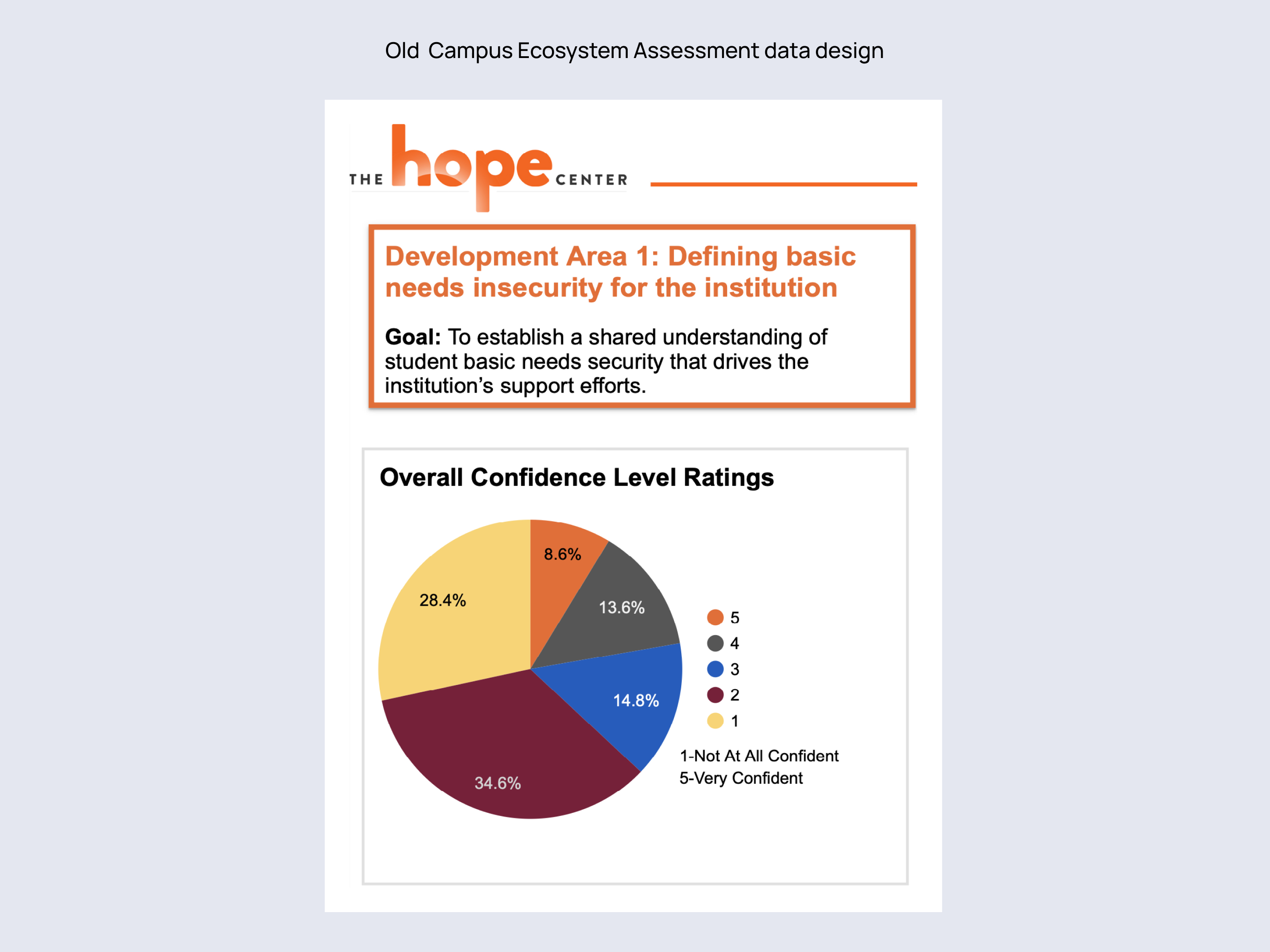
Old Campus Ecosystem data module showing confusing pie chart
No items found.

Outcome

After two years of development (including a rebuilding of the calculation engine), the product launched at the end of June and is being piloted by 65 partners across 80 campuses. You can read the Temple University newsroom post about it, which includes a roadmap for where the dashboard is headed next, including broadening access for policymakers so they can use it to influence legislation.

With the real-time delivery of survey data, institutions will be able to much more quickly assess students’ basic needs, campus policies and programs, and make changes to provide students with targeted support.

At an organizational level, it radically improves The Hope Center’s ability to do technical assistance, and to do it at scale. This additional support increases the impact of partnering with The Hope Center, accelerating the work institutions are already doing to improve graduation rates and advance equity goals.

Use this form to describe your project
Thank you! Your submission has been received!
Oops! Something went wrong while submitting the form.